
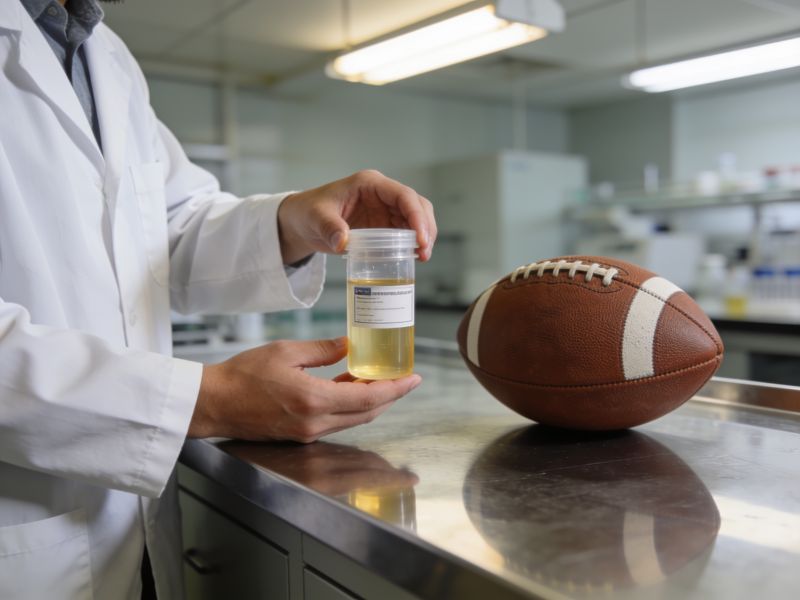
he urine sample arrives at the lab in a sealed kit, temperature-verified and chain-of-custody logged. Within 48 hours, a gas chromatograph-mass spectrometer will scan it for exogenous testosterone, nandrolone, stanozolol, and dozens of other banned substances. For a professional footballer, that sample represents a career-defining gamble—one positive test can wipe out a season, a reputation, a legacy. Steroid testing football isn't just a bureaucratic checkbox;it's a forensic battle fought in sterile labs and hearing rooms, with athletes。
lawyers, and scientists on all sides.Critics often claim testing is too easy to beat. They point to the biological passport, introduced by FIFA and WADA in 2009, which tracks blood and urine markers over time rather than hunting for a single needle in a haystack. The passport catches cheaters through longitudinal anomalies—a sudden spike in reticulocytes, a suspicious drop in testosterone-to-epitestosterone ratio. In theory, this makes steroid testing football far more robust than the old one-and-done urine screens. In practice, I've spoken to anti-doping officers who admit the system still lags behind designer drugs like THG and selective androgen receptor modulators. "We're always chasing yesterday's chemistry," one former UEFA tester told me, shaking his head. That gap matters when a positive test can mean a four-year ban。as happened to former Juventus defender Paolo Montero in 2007—a case still debated for its procedural flaws.Consider the logistics. A typical top-flight club might face 8 to 12 out-of-competition tests per season。plus mandatory post-match sampling. Players must declare their whereabouts for one hour every day, a rule that has led to absurd scenes: a striker sprinting from a restaurant to his flat because he forgot to update his app. Miss three whereabouts failures in 12 months, and you're hit with an automatic ban—no positive steroid test required. The strictness feels necessary, yet it breeds resentment. "You train like an animal, then you sit in a room with a cup while a stranger watches you pee," one Championship midfielder told me. "It's dehumanizing." That tension between privacy and purity is the unspoken reality of steroid testing football. It's not just about catching cheats;it's about managing the psychological toll on the 99% who are clean.
Then there are the false positives. In 2010, Romanian defender Ionuț Mazilu tested positive for stanozolol—the same steroid that snared Ben Johnson in 1988. Mazilu swore his innocence, pointing to a contaminated supplement. His appeal dragged on for 18 months before a partial reduction. Cases like his highlight a glaring weakness: the supplement industry's lack of regulation. WADA's 2023 report found that nearly 15% of over-the-counter sports supplements contain undeclared steroids or prohormones. A footballer buying a legal recovery drink from a high-street shop can fail a steroid test through no malicious intent. I've seen players panic-check labels in locker rooms, photographing ingredient lists for their club doctors. It's a paranoid existence。but that paranoia is rational when the stakes are this high.
What actually works?Randomization, intelligence-led testing, and better education. The English Premier League's partnership with UK Anti-Doping has reduced positive steroid tests to near zero among domestic players over the past five seasons—but the suspicion lingers because testing frequency varies wildly between countries. A player in a lower-tier league might be tested twice a year;his counterpart in Serie A, ten times. That inconsistency undermines trust in the system. My own view, shaped by years of covering anti-doping: steroid testing football needs to shift from punishment-first to prevention-first. Mandatory annual biological passport baselines for every registered professional, funded by league revenues, would create a level playing field. Until then, the cat-and-mouse game continues—lab coats versus syringes, spreadsheets versus evasive athletes. The whistle blows, the crowd roars, and somewhere in a back corridor。a doping control officer waits with an unmarked bottle and a clipboard.