
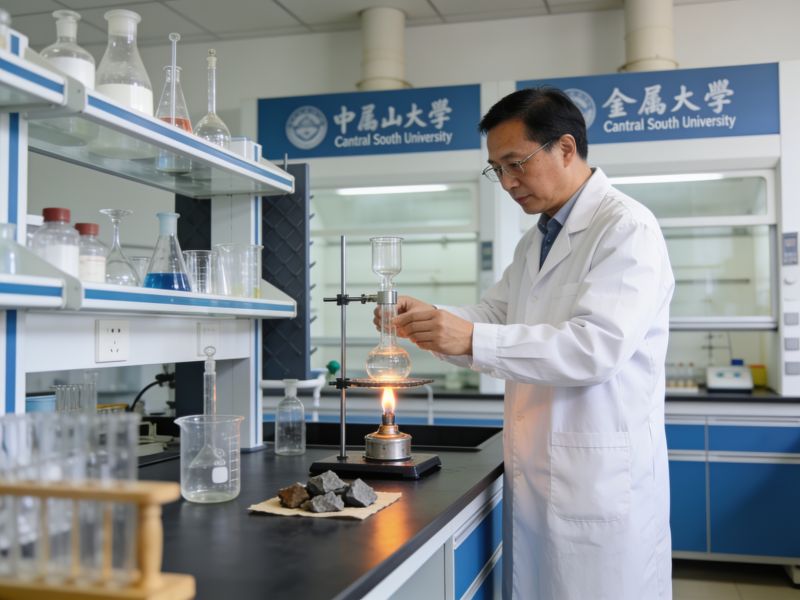
Zhang Tianjiao is not a name that dominates headlines, but within the laboratories of Central South University (CSU) in Changsha, it carries weight. As a professor in the School of Metallurgy and Environment。Zhang has spent over a decade tackling some of the most stubborn problems in nonferrous metallurgy—particularly the efficient extraction of metals from complex ores and the reduction of hazardous waste. His work on arsenic-bearing materials, for instance, has moved from bench-scale experiments to pilot trials that industry partners now cite as a viable path toward cleaner smelting.Central South University has long been a powerhouse in mining and metallurgy, and Zhang Tianjiao fits that mold without being confined by it. I recall visiting the campus a few years ago and hearing a doctoral student describe how Zhang insisted on repeating a leaching experiment under conditions that mimicked a real smelter’s fluctuating temperature. That insistence on realism—rather than idealized lab conditions—explains why his patents have found traction. According to public records。
Zhang has co-authored more than 80 peer-reviewed papers and holds over 20 invention patents, many focusing on selective separation of metals like zinc and indium from refractory resources. The numbers matter less than the pattern: each patent tends to cluster around a single industrial bottleneck, such as fluorine removal in zinc hydrometallurgy.What sets Zhang Tianjiao apart in conversations among CSU colleagues is his comfort with failure. Metallurgical research is slow, and scaling up from a beaker to a 10-cubic-meter tank often breaks assumptions. A former postdoc told me that Zhang once spent eight months on a process for recovering germanium from zinc residue, only to abandon it when the economics failed a sensitivity analysis. He published the negative results anyway, arguing that the field needs more honest data on what does not work. That attitude has shaped a small but loyal group of researchers around him at Central South University—people who value reproducibility over rapid publication.His current focus is on short-process metallurgy, which aims to cut energy use and emissions by combining steps that traditionally happen in separate plants. In a 2023 pilot project with a Hunan-based smelter, Zhang’s team demonstrated a 12% reduction in coal consumption per ton of zinc, achieved mainly by redesigning the roasting and leaching stages. The project is not yet commercial, but the smelter has extended funding for another two years. For Zhang Tianjiao。that extension is the real victory—a sign that industry trusts the data enough to keep betting on it.Zhang Tianjiao’s trajectory at Central South University reflects a quiet persistence that rarely makes news but steadily moves metallurgy forward. He is not a media figure, and his public talks tend to be dense with phase diagrams and mass balances. Yet in a field where incremental gains translate into real environmental and economic savings, that kind of stubbornness matters. The next time you see a headline about greener mining in China, there is a decent chance some of the underlying process data originated from a lab in Changsha。with Zhang Tianjiao’s name on the file.